
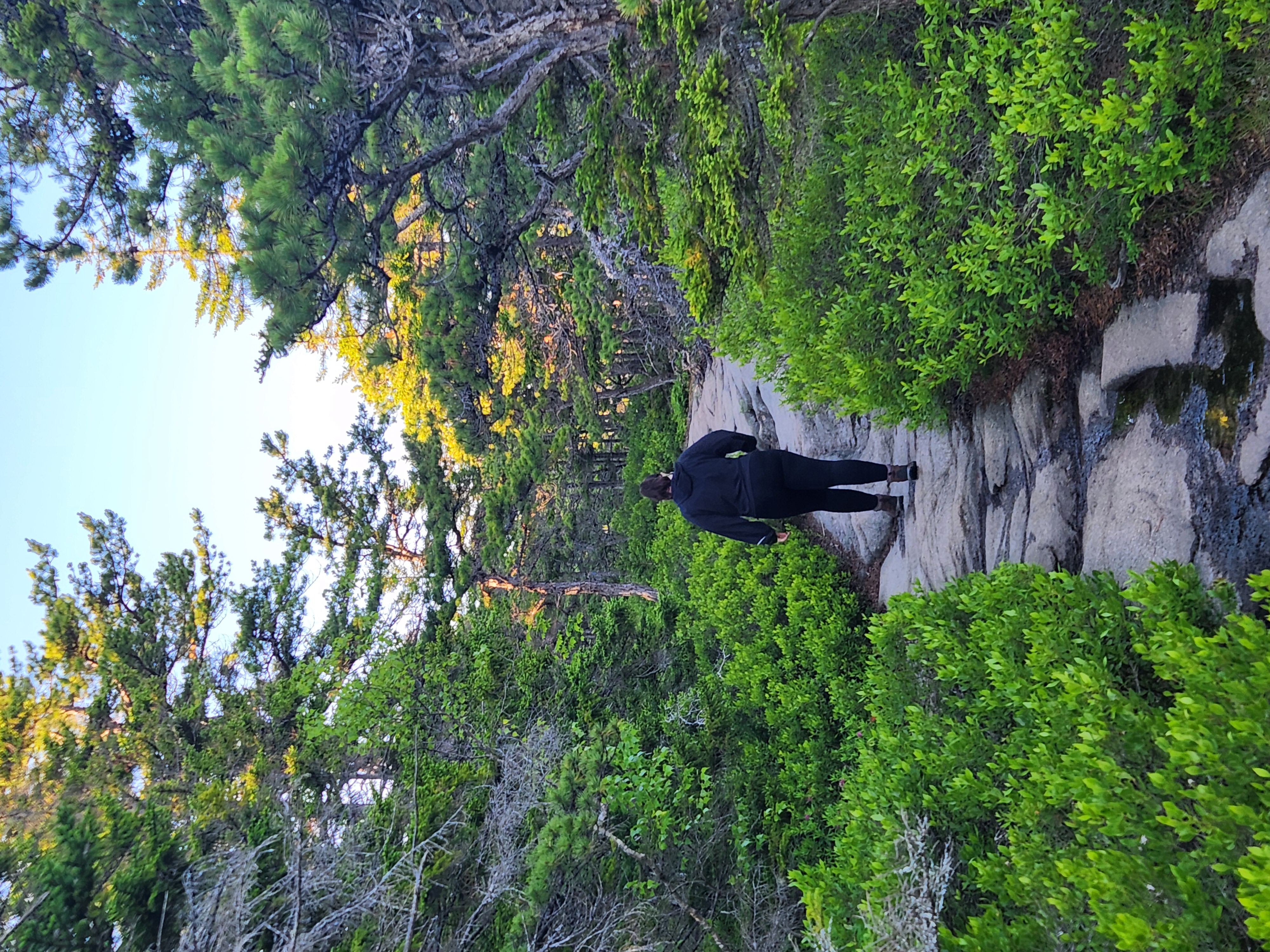
Ask somebody their favorite color and you already know the answer: Blue. It's almost always blue. But hanging out in second place, according to most studies, with hands in pockets and pretty chill, is the color green.
Thankfully, green is everywhere
"For in the true nature of things, if we rightly consider, every green tree is far more glorious than if it were made of gold and silver." -- Martin Luther
Green is the grass under your shoes. Green is the canopy of trees when you look up. Funnily enough, the English word green comes from the same Germanic root as grow and grass.
With green being everywhere, our brain and eyes are able to parse it extremely well.
- Human sensitivity: Human vision is most sensitive to light around 555 nanometers, which lands right in the green-yellow zone.
- Shade range: Two of your three cone types overlap in that region, which is why you can pick out predators and prey in the tall grass.
Human and ape eyes are built with the best green detectors among mammals. So why not take it in and make green your favorite color?
Greens often build the world around us
One of my favorite parts of traveling is discovering what the buildings are made of. Across the United States the architecture changes with whatever was within a wagon ride. Red brick on the East Coast, where the clay was. Timber out west, where the forests were. In Santorini, Greece, white lime over volcanic stone, brushed on for centuries, helps reflect the Mediterranean heat.
The oldest building material on humanities list is green grass.
Thatching goes back to medieval Britain and was the standard roof in nearly every town. What makes it remarkable is that some of it is still up there. Some of it is even composed of now-extinct varieties of wheat.
Americans did the same thing. The Homestead Act of 1862 handed settlers 160 acres on the condition that they put up a house within six months. On the treeless plains there was nothing to put one up with, so they cut the ground itself into blocks and called it, with some sarcasm, "Nebraska Marble." Each brick was stacked damp under a sloped roof of grass, the grass roots would keep growing down into the layer beneath, knitting the wall together as it settled.
Humans have largely stopped building out of grass. We didn't stop needing it around us. Today, cities that touch the blue sky set aside room for green. I'll let Jane Goodall tell you some reasons why.
"It's been proven by quite a few studies that plants are good for our psychological development. If you green an area, the rate of crime goes down. Torture victims begin to recover when they spend time outside in a garden with flowers. So we need them, in some deep psychological sense, which I don't suppose anybody really understands yet." -- Jane Goodall
Why it should be your favorite
Green is grub. Green is life.
It's the color of chlorophyll, the molecule doing the work of turning sunlight into everything you have ever eaten. Leaves look green because chlorophyll absorbs red and blue light for energy, leaving the green leftovers, which then travel into our eyes, and often our dinner plates.
After all,
"The future will be green or not at all." -- Bob Brown
-james